
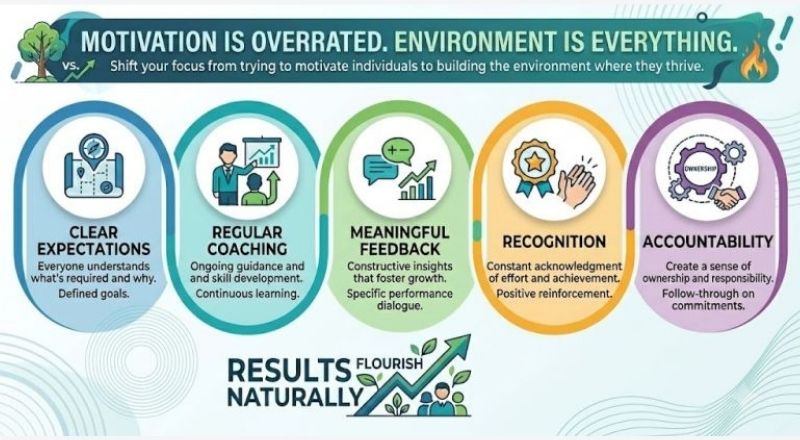
Employee performance is something I see leaders wrestle with regularly. Many ask, “How do I motivate my team?” But the bigger question is often: “What environment have I created for them to succeed?”
Many leaders I work with ask me the same question:
“How do I motivate my team?”
But I believe there is a better question to ask:
“What kind of environment am I creating for my team?”
Because while motivation is important, it is not always consistent.
Some days we feel energised and ready to take on challenges. Other days we are tired, distracted, or dealing with things outside of work.
Motivation naturally comes and goes.
But the environment people work in every day has a much bigger influence on long-term employee performance.
How Workplace Culture Influences Employee Performance
High-performing teams are not built through motivation alone.
They are built through the everyday experiences people have at work.
When individuals operate in an environment that consistently provides:
Clear expectations
Everyone understands what is required, what success looks like, and why their contribution matters.
Regular coaching
People receive ongoing guidance, support, and opportunities to develop their skills.
Meaningful feedback
Constructive conversations help people understand what they are doing well and where they can improve.
Recognition
Effort, progress, and achievement are acknowledged.
Accountability
People take ownership of their responsibilities and understand the impact of their actions.
Performance does not just improve.
It has the opportunity to flourish.
I have personally witnessed individuals who were once considered average performers become strong contributors simply because their working environment changed.
They did not suddenly become different people.
They were given clearer expectations, better support, more feedback, and the opportunity to grow.
The opposite is also true.
Talented people can underperform when they lack coaching, support, or a clear framework of accountability.
This is why effective leadership development is so important. Leaders influence performance through the environment they create, the conversations they have, and the behaviours they model.
The Role of Leaders in Creating High-Performing Teams
Leaders often look for ways to increase motivation, but the most effective leaders focus on creating the conditions where people can do their best work.
This includes developing strong coaching habits, improving communication, and creating a culture where people know what is expected of them.
Research from Gallup consistently highlights the important role managers play in employee engagement. Their research has found that managers have a significant influence on the engagement levels of their teams.
The message is clear:
The environment leaders create has a lasting impact on performance.
A motivational speech might inspire people for a moment.
A supportive workplace culture helps people perform every day.
Creating an Environment Where People Can Succeed
Creating this kind of environment requires intentional conversations.
Through facilitation, leaders and teams can explore what is helping performance, what barriers exist, and what changes could make a difference.
Through coaching, leaders can develop the skills needed to support their people more effectively.
Through practical training, teams can build the behaviours and capabilities needed for long-term success.
Ultimately, workplace culture is the environment people experience every single day.
That environment influences how people communicate, collaborate, learn, and perform.
So the question is not:
“Are my people motivated enough?”
A better question is:
“Am I creating an environment where people have the clarity, support, and accountability they need to succeed?”
What are you doing to create an environment where your team can perform at their best?
Find out more about one-on-one coaching.